
Whether you’re stocking a chilly bin’s worth of venison at a remote high-country hut, keeping the day’s catch frozen on the boat, or simply want a reliable bach freezer that doesn’t rely on the national grid, going off-grid raises one big question: how do you actually keep a freezer running without mains power?
The good news is you’ve got options — and they don’t all work the same way. Some cut mains electricity out of the equation entirely, while others generate their own “mains-style” power on-site. Here are the three main approaches Kiwis use to freeze food off-grid, along with the pros, cons, and best use case for each.
1. LPG Gas Freezers (True Off-Grid, Zero Electricity)
If you want a freezer that runs with no electricity at all, no batteries, no solar, no generator, a gas freezer is genuinely the only way to do it.
Gas freezers use an absorption cooling system rather than the electric compressor found in a normal fridge. A small LPG burner drives a chemical cycle (usually ammonia-based) that produces cold without any moving parts. As long as you’ve got a bottle of gas connected, the freezer keeps running — silently, indefinitely, and completely independent of any power source.
Why Kiwis choose gas:
- Runs 100% on LPG, so there’s nothing to charge and no battery bank to size or maintain
- Completely silent, no compressor hum or generator noise
- Ideal for remote baches, huts, and stations that only get visited occasionally, since a full gas bottle can keep a freezer running for weeks
- No solar panels or wiring required, which suits older or off-grid buildings
Things to weigh up:
- Gas absorption units cool more slowly than electric compressor freezers, so they’re better suited to steady, long-term freezing than fast chill-downs
- The unit needs to sit reasonably level to work efficiently
- You’ll need a reliable LPG supply line, bottled gas, refilled or swapped as needed
Gas is the standout choice for hunters, fishermen, and remote-property owners who need dependable freezing with zero reliance on electricity of any kind. Have a look through our range of 3-way and 2-way LPG gas fridge freezers to see sizes from compact caravan units through to full-size chest and upright freezers.
2. 12V/24V DC Compressor Freezers (Solar & Battery Powered)
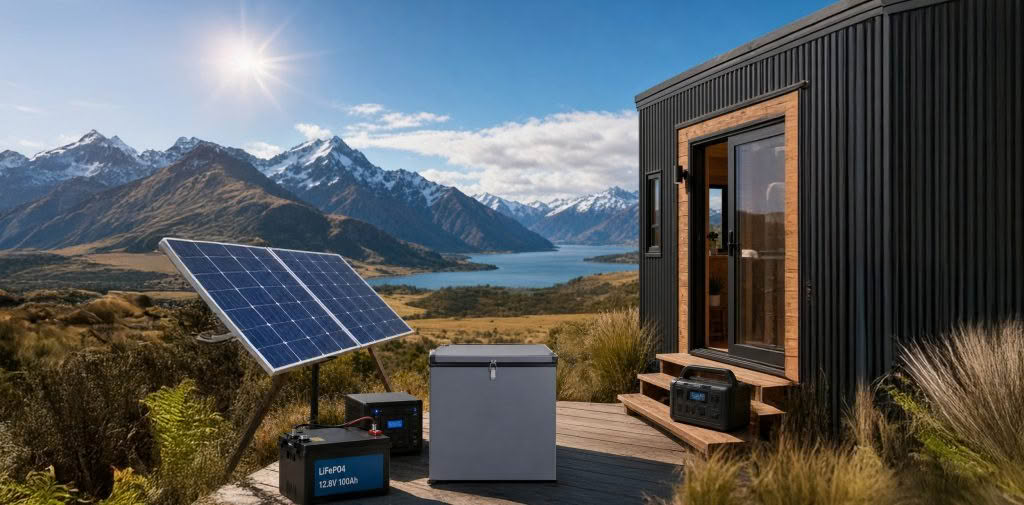
This is the go-to option for anyone with a solar panel and a deep-cycle battery bank — think campervans, boats, 4WDs, and tiny homes. Technically, these units still use electricity, but that power comes from your own battery bank rather than the mains grid, which is why they’re often marketed as “solar fridges” or “12V fridges.”
Unlike a standard household freezer, 12V/24V compressor units are built with low-draw compressors specifically engineered to sip power rather than gulp it, so they won’t flatten your battery overnight.
Why Kiwis choose 12V compressor:
- Cools fast and holds a genuine deep-freeze temperature, even through a hot NZ summer day
- Pairs naturally with a solar panel and battery setup you may already have for lighting, water pumps, and charging
- No gas bottle to carry, swap, or top up
- Great for anything that moves: motorhomes, boats, and 4WDs on the go
Things to weigh up:
- You need enough solar and battery capacity to keep up with the freezer’s draw, especially over several cloudy days
- More components involved (panel, controller, battery, wiring) compared to a straightforward gas setup
- Best suited to vehicles and vessels that are mobile or get regular sun exposure
If your rig is already set up with solar, a compressor freezer is usually the more “set and forget” option. Browse our 12V/24V solar-ready fridges and freezers to find a size that matches your battery bank.
3. Generator-Powered Freezers (Standard Freezer, Portable Power)
The third option is the most flexible but the least “off-grid” in spirit: running a standard 240V freezer off a petrol or diesel generator. Because a generator effectively recreates mains power on-site, you can run almost any standard household freezer without needing gas- or solar-specific equipment.
Why Kiwis choose generator power:
- Works with any ordinary freezer you may already own — no need to buy a specialised off-grid unit
- Useful as a backup or short-term solution, such as during a power cut or a weekend at a bach with no other power source
- Delivers full mains-equivalent power for the freezer and anything else you plug in
Things to weigh up:
- Needs a steady supply of petrol or diesel, plus regular refueling
- Far from silent, and not something you’d want running continuously overnight
- Ongoing running costs and maintenance (oil changes, servicing) add up compared to gas or solar
- Not practical as a long-term, unattended solution for a remote property
Generators earn their place as a backup plan or a stop-gap rather than a primary off-grid freezing strategy, most Kiwis pair one with a gas or solar setup rather than relying on it alone.
Which Option Is Right for You?
| Situation | Best Option |
|---|---|
| Remote bach or hut visited occasionally | LPG Gas Freezer |
| Hunting, fishing, or a station with no power at all | LPG Gas Freezer |
| Campervan, motorhome, or boat with solar already installed | 12V/24V Compressor Freezer |
| Backup power during outages, or short-term use at a bach | Generator |
For most permanently off-grid properties, gas wins on simplicity and independence, there’s nothing to charge and nothing to run out of sun. For anything mobile with an existing solar setup, a 12V/24V compressor freezer is hard to beat on cooling performance. And a generator is a handy fallback to have in the shed, even if it’s not your everyday solution.
Need a Hand Choosing?
At Offgrid Appliances, we stock a wide range of off-grid fridges/freezers, from rugged LPG gas freezers built for remote stations to high-efficiency 12V/24V compressor units for baches, boats, and RVs. Contact us, and our team can help match a freezer to your setup, your power source, and your budget.